Design operations: scale creative output without hiring
TABLE OF CONTENTS

TL;DR: Design operations (DesignOps) is how marketing teams scale creative output without adding headcount. The core problem is rarely a lack of designers. It's unclear briefs, broken approval chains, and no system for prioritizing what gets designed first. Fix those three things and most teams unlock 2-3x more output from the resources they already have. If you still need more capacity after that, external design partners are almost always a better next move than a full-time hire.
What is design operations (and why it's not just for product teams)?
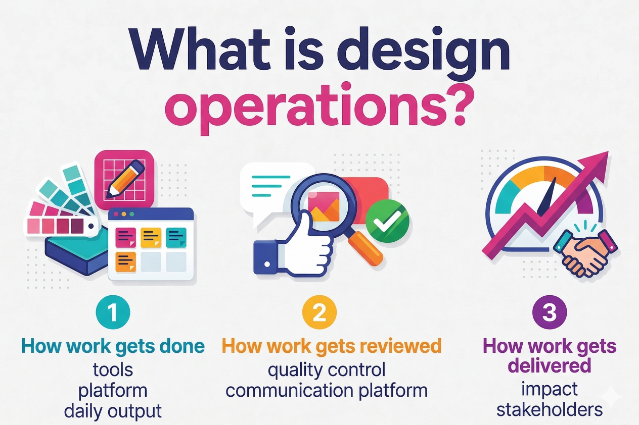
Design operations is the system behind how design work gets requested, prioritized, produced, reviewed, and delivered. The Nielsen Norman Group defines it as "the orchestration and optimization of people, processes, and craft in order to amplify design's value and impact at scale."
That's a mouthful. Here's what it means in practice: design ops is everything that happens around the creative work itself. Not the Photoshop file. Not the brand guidelines. The intake form. The approval flow. The feedback loop. The way requests move from "someone's head" to "delivered asset."
The term comes from product design and UX, where large teams needed a way to coordinate dozens of designers working on the same product. But the discipline applies just as directly to marketing teams, brand departments, and agencies. If you have people requesting design work and people producing it, you have a design operation. The question is whether you're running it intentionally or by accident.
Most marketing teams are running it by accident.
That's not a criticism. It's a pattern. You start with one designer, a shared Slack channel, and good intentions. It works until it doesn't. The requests pile up. The designer becomes a bottleneck. Someone says "we need another designer." And maybe you do. But more often, you need a system first.
Why creative output stalls: the real constraint isn't headcount
The instinct when creative output slows down is to throw people at the problem. It feels logical. More designers equals more output. But the math rarely works that way.
Research from MarTech's 2026 Creative Ops report found that 77% of marketing teams report increased project volume year over year, while 45% struggle to keep up with content demands across channels. The same research points to where the real friction lives: approval bottlenecks, unclear priorities, and constant reorientation are what actually slow teams down.
We’ve seen this pattern play out hundreds of times from the operations side at ManyPixels. A new customer signs up, convinced they need more design capacity. They're right that they're behind. But when we look at their request queue, the slowdown isn't production.
⌛ It's the three days between a first draft and someone giving feedback.
😕It's the brief that says "make it pop" and requires two rounds of revisions to clarify what that meant.
💬 It's the project that sat in "waiting for approval" for a week because three stakeholders needed to sign off and none of them knew they were in the loop.
Add a second designer to that environment and you get two people waiting on the same broken feedback loop.
This is what makes design ops valuable before hiring. It doesn't add capacity. It unblocks the capacity you already paid for. And the numbers back this up: CMO Alliance reports that 59% of CMOs say their budgets aren't enough, and burnout was the top concern for 25.9% of team leads. The response can't always be "spend more." Sometimes the response is "spend better."
The four pillars of a functional design ops model
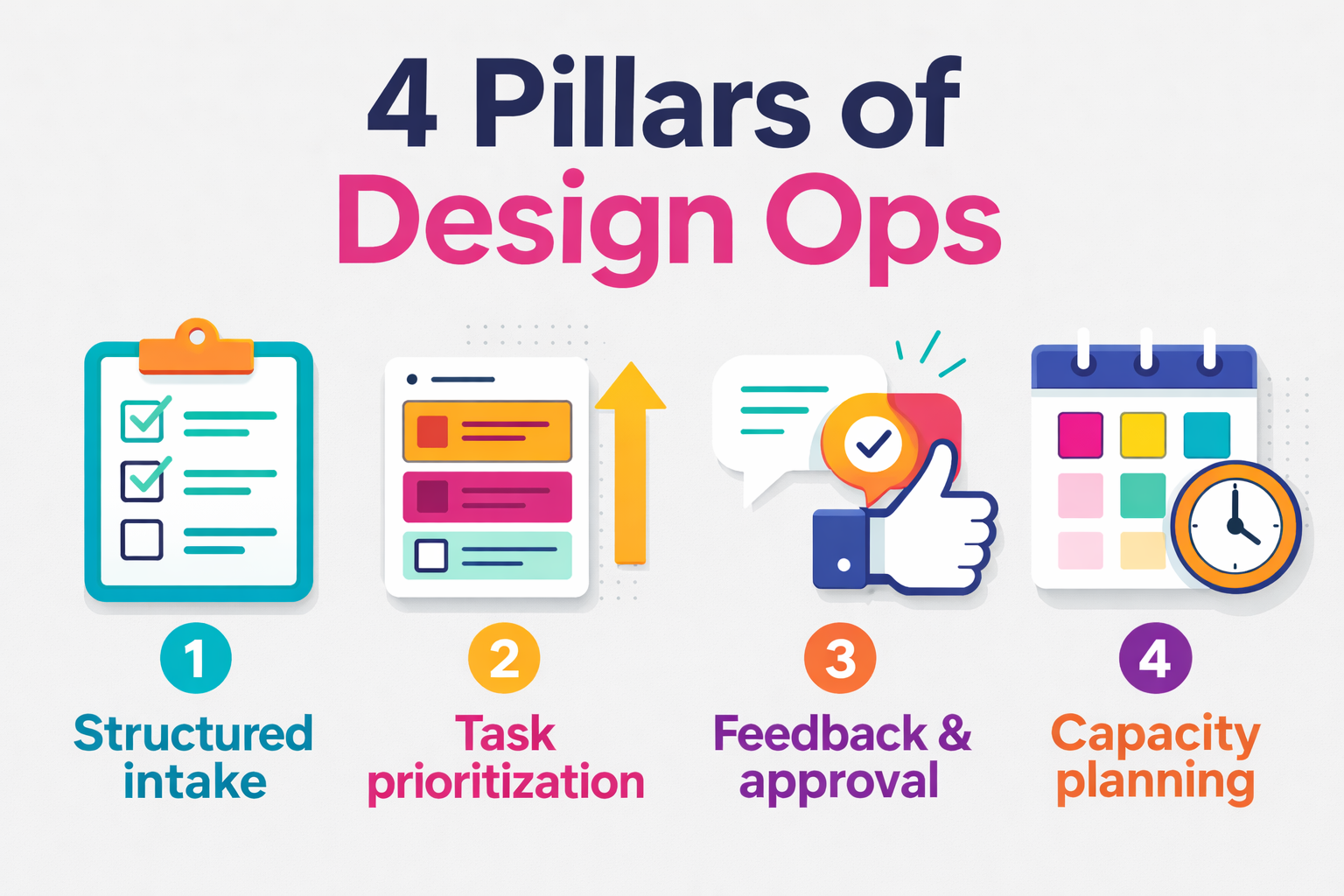
Design operations isn't one thing. It's four systems working together. You don't need all four to be perfect. You need all four to exist.
1. Structured intake: how work enters the system
Every design request should enter through the same door. That might be a form, a project management tool, or a shared brief template. The format matters less than the consistency.
A good intake system captures three things before any design work starts: what the deliverable is (format, dimensions, where it will be used), what it should communicate (message, audience, tone), and when it's needed (actual deadline, not "ASAP").
Creating a quality brief is the foundation of a smooth design process. At ManyPixels we make things easier through our custom platform. Customers need to fill out the simple form, which then provides designers with key information to start working (type of design, format, color scheme, etc.).
If you only fix one thing on this list, fix your briefs. Use a design workflow checklist and make it mandatory. No brief, no spot in the queue.
2. Prioritization: how you decide what gets done first
When everything is urgent, nothing is. Most creative bottlenecks aren't about speed. They're about the team not knowing which of the 14 open requests actually matters this week.
A simple priority framework works better than a complex one. Try this: every request gets tagged as either "revenue-impacting" (launches, campaigns, sales collateral), "brand-building" (social content, thought leadership, evergreen assets), or "internal" (decks, reports, one-off asks). Revenue-impacting work gets produced first. If your designer is spending Monday on an internal deck while a product launch sits in the queue, that's not a capacity problem. It's a prioritization problem.
From our experience it’s always best if one person owns the queue. One person, usually the marketing manager or project lead, decides the order. Designers design. Ops decides sequence.
3. Feedback and approval: how work gets finished
This is where most teams leak the most time. The design is done in a day. The feedback takes a week. Then the revision takes another day. Then silence again.
Industry data from Screendragon confirms what most marketing managers already feel: approval bottlenecks and constant reorientation are the top workflow killers, not production speed.
Fix this with three rules.
- Every request has one approver, not a committee. If stakeholders need input, they give it before the brief is submitted, not after the first draft.
- Set a feedback SLA. 24 hours for review is reasonable. If the approver doesn't respond within that window, the request moves to the back of the queue.
- Feedback should be specific. "I don't like it" is not a revision request. "The headline font is too casual for a B2B audience, try a structured sans-serif" is.
4. Capacity planning: how you match supply to demand
Once intake, prioritization, and approval are running, you can finally see your actual capacity gap. Not the perceived one (where everything feels behind) but the real one (where demand consistently exceeds what your team can produce even with clean workflows).
This is the pillar where external design capacity enters the picture. And it's important that it comes last. If you bring in outside help before fixing the first three pillars, you just scale the dysfunction. More output, same bottlenecks, more waste.
But once the system is clean, capacity planning becomes straightforward math. Track how many requests your team completes per week. Track how many come in. If incoming consistently exceeds output by more than 20%, you need more production capacity.
Design subscription services are the easiest way to scale. You get access to a team of designers, while paying a predictable monthly rate. It’s also possible to scale up, down or even pause your subscription as you go.
How to audit your current design workflow in one afternoon
The short version: map how a design request currently moves from idea to delivered asset. Every handoff, every wait state, every approval step. Then look for the longest gaps. Those gaps are your design ops opportunities.
Here's the full audit:
Question 1: Where do design requests come from? List every channel. Slack DMs, email, verbal asks in meetings, project management tools, "can you just quickly..." conversations. If requests enter through more than two channels, that's your first fix.
Question 2: What information do requesters provide upfront? Pull the last 10 design requests your team received. How many included dimensions, copy, brand assets, and a clear deadline? If fewer than half did, your intake process is costing you revision rounds.
Question 3: How long does each stage actually take? Pick five recent projects and map the timeline. When was the request submitted? When did design work start? When was the first draft delivered? When did feedback come back? When was the final version approved? In most teams, production time is 20-30% of total elapsed time. The rest is waiting.
Question 4: Who approves, and how many people touch the work before it's done? If more than two people review a standard social graphic before it ships, your approval chain is too long. Every additional reviewer adds 1-2 days of elapsed time on average.
Question 5: What percentage of requests require more than one round of revisions? If it's above 40%, the problem is upstream (brief quality or misaligned expectations), not downstream (designer skill).
Write down what you find. You'll almost certainly discover that your team's actual production capacity is being masked by process inefficiency. That's good news. It means you can fix it without spending money.
When to bring in external design capacity vs. hire
Once your design ops foundation is solid and you still have a capacity gap, you're facing the real decision: hire a full-time designer or bring in external capacity?
Here's how I'd think about it.
If you need strategic design leadership (someone to own your visual identity, make brand judgment calls, direct other designers), that's a hire. No external partner replaces a senior creative who deeply understands your brand from the inside.
If you need consistent production across predictable asset types (social graphics, ad creatives, landing pages, presentations, marketing collateral), external capacity is almost always the smarter move. A full-time mid-level designer costs $65,000-$85,000+ per year in salary alone, before benefits, software licenses, management overhead, and the 3-4 months it takes for a new hire to reach full productivity. That's a significant fixed cost for what might be a variable need.
The models that work well for marketing teams fall into three categories.
- Freelancers work for project-based, highly specialized needs (custom illustration, motion design for a specific campaign).
- Agencies work when you need strategic creative direction alongside production.
- Graphic design subscriptions work when you need reliable daily output across a range of standard marketing asset types, which is where most marketing teams actually live.
If you're outsourcing graphic design for the first time, the subscription model is worth understanding because it functions as an ops layer, not just a vendor. You submit requests through a structured system, get daily output, and maintain a predictable cost.
However, if you're producing fewer than 8-10 design assets per month, a freelancer is probably more cost-effective. Above 15-20 per month with consistent variety? That's where subscription models or a dedicated external team start making financial sense.
Frequently asked questions
Do you need a dedicated DesignOps person to implement design operations?
No. Most marketing teams under 20 people don't need a dedicated DesignOps hire. The marketing manager, project manager, or head of brand can own the function. What matters is that someone owns it. Design ops fails when it's "everyone's responsibility," which in practice means it's nobody's.
What's the difference between design operations and creative operations?
Creative operations is the broader discipline that covers all creative production: copywriting, video, photography, and design. Design operations focuses specifically on the design workflow. For most marketing teams, the terms are interchangeable because design is the primary creative bottleneck. If your team also produces video or written content at scale, creative ops is the better frame.
How long does it take to see results from implementing design ops?
Most teams see measurable improvement within 2-4 weeks of fixing their intake process and establishing a single approver per request. Those two changes alone reduce average cycle time by 30-40% in our experience. Full implementation of all four pillars typically takes 2-3 months of iteration.
Is design operations relevant if my team only has one designer?
Especially then. A solo designer is the most common bottleneck in marketing teams, and they're also the most affected by broken processes. When one person handles all design work, every vague brief, every delayed approval, and every unplanned "urgent" request directly impacts their output. Design ops protects your designer's productive time.
Can AI replace the need for design operations?
AI tools (Canva AI, Adobe Firefly, Midjourney) can accelerate parts of the production process, but they don't solve operational problems. An AI tool can generate a social graphic in 30 seconds. It can't decide which of your 12 pending requests should be produced first, whether the output matches your brand guidelines, or who needs to approve it before publishing. AI is a production tool. Design ops is the system that tells you what to produce, in what order, and how to get it approved.
What tools do I need for design operations?
You need less than you think. A project management tool (Asana, Monday, Trello, or even a shared spreadsheet), a brief template, and a shared folder for delivered assets. That's the minimum viable stack. Don't buy a dedicated DesignOps platform until you've proven the process works with simple tools first. The workflow matters more than the software.
Bottom line
Design operations is the highest-leverage investment a marketing team can make before adding headcount.
Fix your intake, set clear priorities, streamline approvals, and measure what's happening. Most teams discover they have 40-60% more capacity than they thought. For the gap that remains, external marketing design services are almost always faster and more cost-effective than a full-time hire.
{{GRAPHIC_BANNER="/dev/components"}}
Start with the process. The capacity follows.

Having lived and studied in London and Berlin, I'm back in native Serbia, working remotely and writing short stories and plays in my free time. With previous experience in the nonprofit sector, I'm currently writing about the universal language of good graphic design. I make mix CDs and my playlists are almost exclusively 1960s.

Top-quality designers
A complete creative team at your fingertips: graphic and web designers, illustrators, and more.

Lightning-fast turnaround
Get start today and receive your first update on the next business day.

All-inclusive pricing
Unlimited requests and revisions. One flat monthly fee. No surprises.

Flexible & scalable model
No contract. Scale up and down as needed. Pause or cancel at anytime.
Continue reading


Explore some of our best designs
Get inspired by a curated selection of ManyPixels work. Download the portfolio to see what our team can create.