Design subscription red flags: 9 things to check before you sign
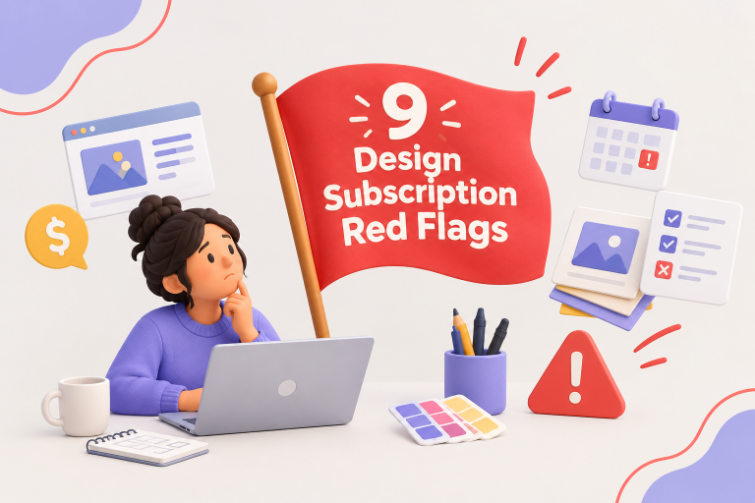
TABLE OF CONTENTS
TL;DR
The biggest design subscription red flags are not on the price tag. They sit in the exit terms and in what "unlimited" quietly caps at: intro rates that expire, scope locked to a higher tier, minimum commitments next to "cancel anytime", no refund combined with a lock-in, and files that disappear when you cancel. Check the FAQ and the terms, not just the pricing cards.
- ✅ Most important check: find the minimum commitment. Design Buffs advertises "no contracts" and states a three-month minimum on the same page.
- 💰 Price check: ask what you pay in month six. Kapa99's $349 is a two-month intro rate on a $499 plan.
- 🎨 Scope check: confirm your work is on the tier you are buying. Awesomic's UI/UX starts at $2,995/mo, not the $1,490 entry plan.
- ⚠️ No refund is only a red flag with a lock-in. Monthly billing with no minimum term limits your risk to one month.
- ❌ Skip any service that can't tell you its daily output, active request limit or monthly hours in one sentence.
Every design subscription pricing page says roughly the same thing. Unlimited requests. Unlimited revisions. Cancel anytime. The monthly price is the one number that changes, so that is where most buyers look.
It is also the least informative number on the page. The things that decide whether a design subscription works for you, or quietly costs you three months of fees you didn't plan for, live in the FAQ, the terms of service and the tier comparison grid. Those are the places to look for design subscription red flags.
1. Is the headline price the price you'll pay in month six?
A design subscription's headline price is often an introductory or promotional rate. Before you sign, find the regular monthly rate, how long the intro price lasts and whether it depends on prepaying a quarter or a year. The honest comparison number is what you pay in month six on monthly billing.
This is the most common pricing pattern we see. Kapa99 shows $349/mo for its Async Standard plan, which is the rate for the first two months only. The standing price is $499. Kimp advertises $699/mo as a promotional rate that steps up after the intro term.
None of this is dishonest. It just means the cheapest number on a roundup is often a number nobody pays for long. The same goes for billing terms: one plan can show three prices depending on whether you pay monthly, quarterly or yearly. Write the billing term next to every price you compare, or you are comparing different things. Our list of the most affordable design subscriptions uses standing monthly rates for exactly this reason.
2. Does the work you need sit on the tier you're buying?
https://www.manypixels.co/blog/get-a-designer/are-unlimited-design-services-really-unlimited Those services usually sit on a tier costing two to three times more. Before signing, match each type of work you need to the cheapest tier that includes it, and treat that tier as the real price.
Scope gating is the red flag that costs buyers the most, because it only shows up when the first web request bounces. A few examples from pricing pages we checked in September 2026:
- Awesomic's Graphic Pack is $1,490/mo, but UI/UX and product design start on All-in-One at $2,995/mo.
- Delesign's Marketer Growth plan is $649/mo. Web design, video editing and motion graphics sit on Agency Booster at $849/mo.
- DotYeti starts at $995/mo. Web design, UI/UX, motion and video editing all start on Summit at $2,595/mo.
- No Limit Creatives only includes web and UI/UX on its Full Stack plan. The $500/mo figure some sites quote is the self-managed Digital Ads plan, which covers ad creative only.
None of these tiers are hidden. They are just easy to miss when you look at the first price card and move on. The entry price is only your price if the entry tier covers everything on your list.
{{GENERAL_PORTFOLIO="/dev/components"}}
3. "Cancel anytime" on one part of the page, a minimum term on another
The most concrete red flag we found this year was on Design Buffs' pricing page, checked on 12 October 2026. The features list says "Flexible subscription, no contracts, cancel/pause any time." The FAQ on the same page says "The minimum commitment is three months." Both statements are live at the same time.
Design Buffs is not the only service with a commitment. They just state it in two places that disagree. Other forms of commitment to look for:
- Annual contracts. Superside runs every subscription on an annual commitment, from a $15,000/mo minimum, plus a separate $1,000/mo software fee.
- Discount locks. Awesomic's quarterly rate ($1,190/mo for Graphic Pack) comes with a three-month lock.
- Prepaid terms that auto-renew. Quarterly and yearly plans are cheaper, but on most services, ours included, they renew automatically for another full term unless you cancel first.
A commitment is not a problem in itself if you know about it. If you are weighing longer commitments, our comparison of a subscription or agency retainer covers when a fixed term makes sense. The red flag is a commitment you only discover in the FAQ, after reading "cancel anytime" in the headline.
4. Does "unlimited" come with a number you can plan around?
"Unlimited" in a design subscription means unlimited requests in a queue, not unlimited output. Every legitimate service caps throughput somehow: active requests at a time, a daily output, or hours per month. If a provider can't tell you that number in one sentence, you can't predict what a month of fees will buy.
The cap itself is not a red flag. Every human design team has one. What matters is that it is stated, and that it fits your volume:
That last question matters more than people expect. Flocksy rolls unused hours over for up to 30 days. Designity's hours do not roll over. If your requests come in bursts, that difference is worth real money.
We cover the maths of output per month in detail in what "unlimited" actually means. For this checklist, the test is simpler. If the sales page won't put a number on capacity, assume the number is lower than you need.
5. Is a no-refund policy a red flag?
A no-refund policy is only a real red flag when it comes with a minimum commitment or with no way to test the service first. On a monthly plan with no minimum term, your maximum loss is one month of fees. On an annual or three-month contract with no refund, a bad fit costs you the whole term.
Refund policies vary more than most buyers realise. Designjoy offers 75% back if you are not happy after the first week, and no refunds after that. No Limit Creatives' own FAQ, checked on 22 September 2026, says "We do not offer refunds if you cancel your design plan early" and "We do not offer any trial period."
To be fair, we should say where we stand. ManyPixels' terms of service say all subscription fees are non-refundable, and we don't offer a free trial. What limits the risk is that there is no minimum term: you can cancel any time, and the cancellation takes effect at the end of the billing period you've paid for.
It’s also worth considering the two sides of a refund policy. On one hand, it gives customers a chance to test the service and make an informed decision about making a commitment. On the other it can often lead to abuse and people simply wanting to get a week or two of design work for free. With the typically large output you get with a design subscription service, this is a considerable amount of work to simply give out for free.
6. You "own" the designs, but do you get the files?
Almost every design subscription says you own what it delivers. That part is rarely the problem. Ownership on most services is conditional on paying in full, which is normal and fair. The red flags are narrower, and they show up in the file list rather than the ownership clause.
Three things to check:
- Native source files, by name. "Editable files" can mean a layered Adobe or Figma file, or it can mean a Canva link. If you will hand work to another designer or agency later, ask for the specific formats on your plan.
- Stock and font licences. Ownership of the design does not transfer ownership of the stock photos or fonts inside it. Our own terms say licensed stock content stays subject to its original licence, and most services work the same way. Ask whether the licence covers your use, such as paid ads or print runs.
- Ownership versus a licence to use. Read the exact wording. "You own the deliverables" is different from "you receive a license to use the deliverables".
If the provider can't list the source file formats you will receive, treat that as the answer.
7. What happens to your files when you cancel?
On most design subscriptions, access to your delivered files ends when the subscription ends, and the provider has no obligation to store or re-send them. Before you sign, check whether cancellation deletes your library, whether a paid pause keeps access, and plan to download source files as each project closes.
This is the red flag almost nobody checks, and we'd rather be upfront that our own terms are part of it. ManyPixels' terms say that after cancellation, access ends, associated data may be deleted on our retention schedule, and we are not obligated to re-deliver files. Pausing for $10/mo keeps your file access while you stop submitting requests.
Most subscriptions work this way, because storing every client's library forever isn't part of a monthly fee. The practical fix takes five minutes a week. Download the final source files when each project closes, and keep them in your own drive, organised by brand. Your design platform is a workspace, not an archive.
8. Who actually does the work, and will it be the same person next month?
Design subscriptions use one of three models: a shared pool of designers, a dedicated or assigned designer, or a single founder doing everything. Before signing, ask which one you are buying, whether you can request the same designer again, and who covers holidays and sick days.
Each model has a real trade-off. A pool spreads work across whoever is available, which keeps turnaround steady but can make the style drift from one request to the next. A single-person studio like Designjoy, whose own FAQ describes it as a one-man agency, gives you perfect continuity and no cover when that person is unavailable. An assigned designer sits in between.
For what it's worth, continuity is what most of our own customers end up paying for. 72% of ManyPixels customers choose the Assigned Designer or Design Team plans, where the same part-time designer works on your requests in your time zone. On our queue-based plans you can still choose a designer. If style drift is your main worry, our guide on how to avoid generic designs covers the brief side of the problem. Ask "will the same person work on my next request?" and expect a straight yes or no.
9. The reviews describe a service that no longer exists
This one doesn't appear in any checklist we've seen, and it caught us out more than once while updating our own articles. Design subscriptions change their pricing, tiers and policies often, and third-party reviews rarely keep up. A review can be accurate on the day it was written and wrong about everything you are about to buy.
Three examples from this year:
- No Limit Creatives rebuilt its pricing in 2026 and moved to nlc.com. Its G2 listing still shows a 14-day money-back guarantee, while the company's own FAQ now says no refunds and no trial.
- Reel Unlimited rebranded as Renlar in November 2025, with different plans. Many roundups still quote the old Reel Unlimited price.
- Design Pickle removed public pricing and now quotes on a sales call. Any article citing a Design Pickle monthly price is quoting an estimate or an old page.
Reviews are still useful for things that change slowly, like communication and quality. For pricing, refunds and scope, only trust the live pricing page and FAQ, read the week you sign. Our No Limit Creatives alternatives page shows how far a service can drift from its reviews. If a review doesn't show a date, assume the pricing in it is out of date.
Then send one real project as your first request, not a throwaway test. A real brief shows you turnaround, communication and quality on work you actually need.
FAQs
Bottom line
The design subscription red flags that cost buyers money are rarely on the price card. They are the minimum term behind "cancel anytime", the scope that lives one tier up, and the refund policy read without the contract length next to it.
Spend 20 minutes on the FAQ and the terms before you compare monthly prices. If a service still looks good after that, it probably is. If you'd like to run the same checks on us, explore ManyPixels plans and read our terms first. We'd rather you sign knowing exactly what you're getting. Or book a 1:1 consultation to ask us any questions.
{{GRAPHIC_BANNER="/dev/components"}}

Having lived and studied in London and Berlin, I'm back in native Serbia, working remotely and writing short stories and plays in my free time. With previous experience in the nonprofit sector, I'm currently writing about the universal language of good graphic design. I make mix CDs and my playlists are almost exclusively 1960s.

Top-quality designers
A complete creative team at your fingertips: graphic and web designers, illustrators, and more.

Lightning-fast turnaround
Get start today and receive your first update on the next business day.

All-inclusive pricing
Unlimited requests and revisions. One flat monthly fee. No surprises.

Flexible & scalable model
No contract. Scale up and down as needed. Pause or cancel at anytime.
Continue reading

Explore some of our best designs
Get inspired by a curated selection of ManyPixels work. Download the portfolio to see what our team can create.