Graphic design prices in 2026: the full price list

TABLE OF CONTENTS
TL;DR
- ✅ Freelancers are cheapest for one-off projects. Typical rates: $25–$150/hr or $200–$800+ per project.
- ✅ Subscription services like ManyPixels are most cost-effective for ongoing needs. Flat monthly pricing, no per-project fees.
- ❌ Agencies are rarely worth it for routine marketing work. Projects typically start at $3,000+.
- ❌ Hiring in-house only makes sense at consistent, high volume. Expect $50,000+ per year in salary alone, before benefits.
Introduction
There's no single answer to "how much does graphic design cost", and anyone who tells you otherwise is either selling something or hasn't looked at enough quotes. You'll find freelancers charging $50 for a logo and agencies billing $15,000 for the same brief. Both prices can be justified. Neither is automatically right for your business.
Graphic design prices in 2026 run from roughly $25/hr for freelance work to $5,000/mo for enterprise creative retainers. What you pay depends on four things: who does the work, what you are asking for, how often you need it, and where your designer sits.
Here is the full price list, by service type, by hourly rate, and by provider model, with the numbers laid out so you can match the right option to your actual volume instead of the cheapest looking quote.
How much does graphic design cost in 2026?
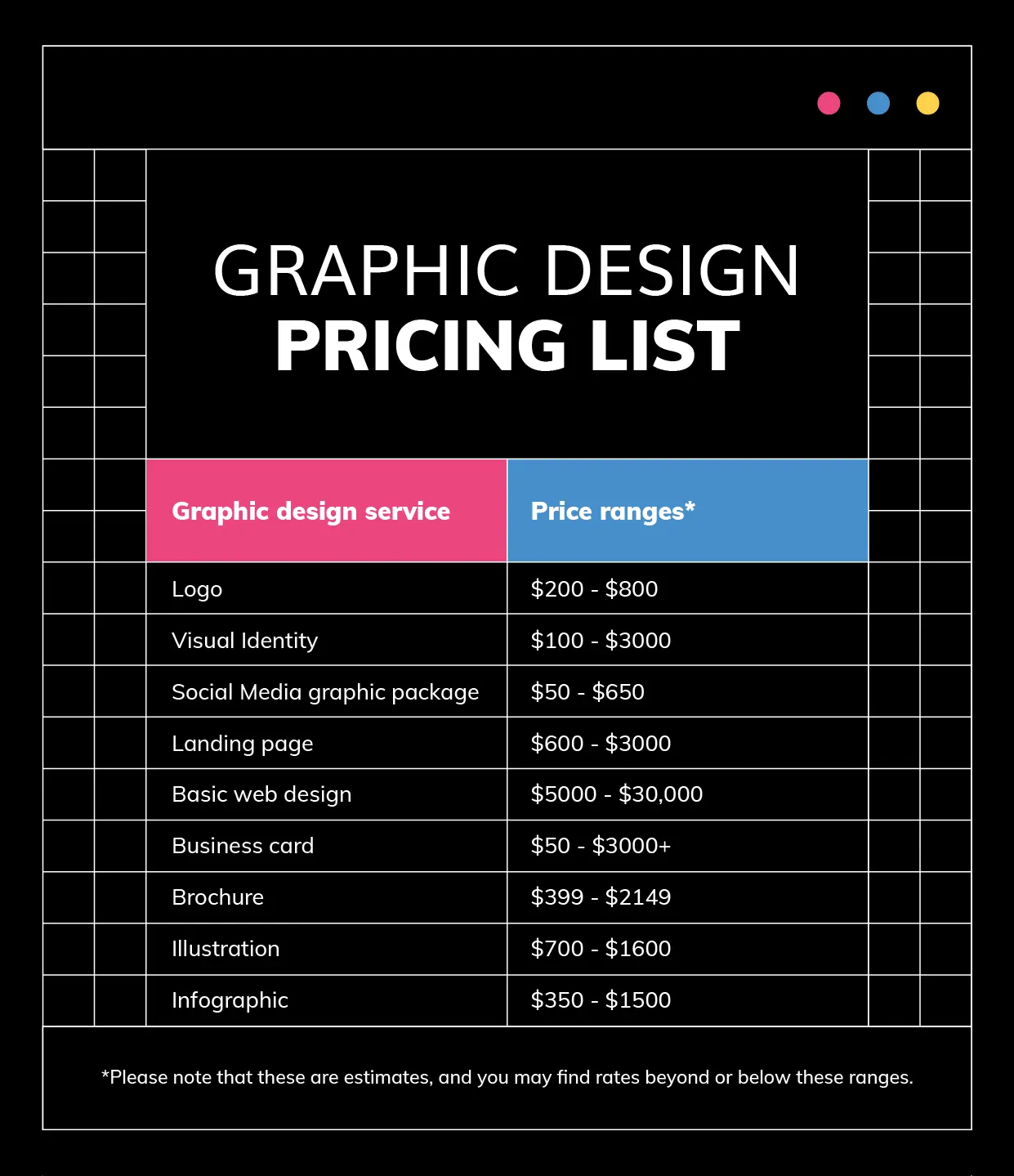
Graphic design costs $25 to $150 per hour for freelancers, $75 to $175 per hour at agencies, and $499 to $5,000 per month for a design subscription. Per project, a logo runs $200 to $800, a landing page $600 to $3,000, and a full website design $5,000 to $30,000. Most small businesses spend $500 to $2,500 a month on design in total.
The number that actually decides your budget is volume, not rate. A $65/hr freelancer looks cheap until you are booking ten hours a week, at which point you are at $2,600 a month with none of the consistency a subscription gives you. Below three or four requests a month, freelancers usually win on price. Above that, the maths flips.
Prices reflect US market rates as of 2026. Rates outside North America and Western Europe typically sit 30 to 50 percent lower.
What affects graphic design prices?
Four factors drive most of the variation in graphic design pricing: who does the work (freelancer, agency, or subscription service), what you're asking for, how complex and revision-heavy the project is, and where your designer is based. Getting clear on these four upfront makes it much easier to budget accurately and avoid quote shock.
1. Provider type. The biggest variable. A freelancer, an agency, and a subscription service operate on completely different pricing models. The same logo brief could cost $300 from a mid-level freelancer, $5,000 from a mid-sized agency, or come included in a $699/month subscription. More on this in the comparison section below.
2. Project complexity. A simple social media graphic takes a few hours. A full brand identity system (logo variants, typography, color palette, and brand guidelines) can take several weeks. Complexity drives hours, and hours drive cost.
3. Volume and frequency. One-off projects make freelancers look cheap. Once you're ordering five, ten, or twenty design tasks a month, per-project costs stack up fast. This is where subscription services tend to pull ahead on value.
4. Designer location and experience. Senior US-based designers charge more than junior designers based in Eastern Europe or Southeast Asia. Remote work has made the global market more accessible, which is why hourly rates vary as much as they do.
Typical graphic design costs (2026)
Here are some typical freelance graphic design rates for common design projects (note that agencies will usually charge much more). Also bear in mind that rates vary based on several factors, such as type of project, location and experience of the graphic designer.
Logo design: ~$200 – $800
A professional logo involves research, concepting, and multiple client revisions. Freelance graphic designers charging by project usually stay within this price range. Although of course the number of iterations (which can be critical for a logo) can bump up the price.
Worth knowing: quotes of $50 to $100 exist on freelance marketplaces, but the output is almost always a reworked template rather than an original mark. Budget $300 minimum for something that holds up at small sizes and across contexts.
Visual identity systems: ~$100 – $3,000
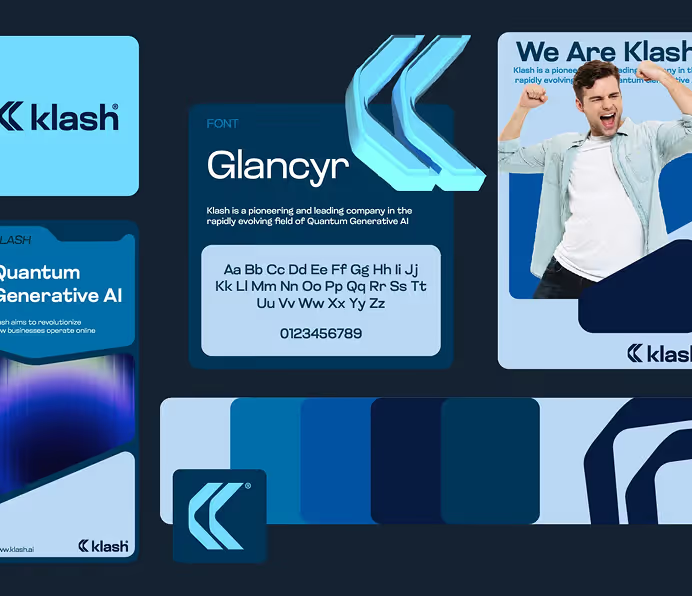
Visual identity covers logo variants, colour palettes, typography and written brand guidelines. This is the difference between having a logo and having a brand that stays consistent when three different people are making assets.
Social media graphics: ~$50 – $650 per batch
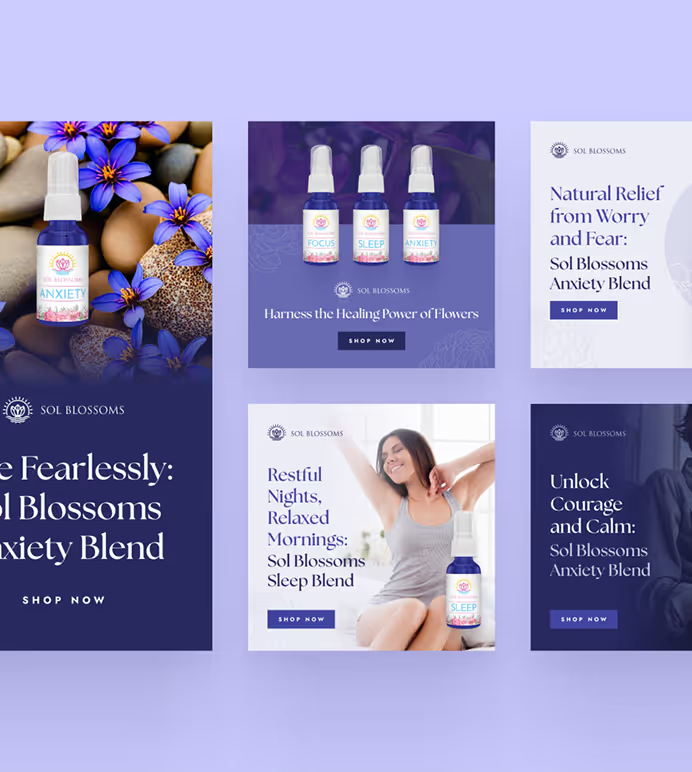
Individual posts sit at the low end. Campaigns with custom templating cost more. Be careful comparing quotes here: there is a large gap between two post designs and a full monthly content calendar. Our breakdown of social media design costs covers the scope question in detail.
Landing page design: ~$600 – $3,000
Typically cheaper than full websites but still requires UX thinking and custom layouts. Still, don’ t expect to pay anything less than around $1,000 if you want a decent and functional page.
Web design: ~$5,000 – $30,000+
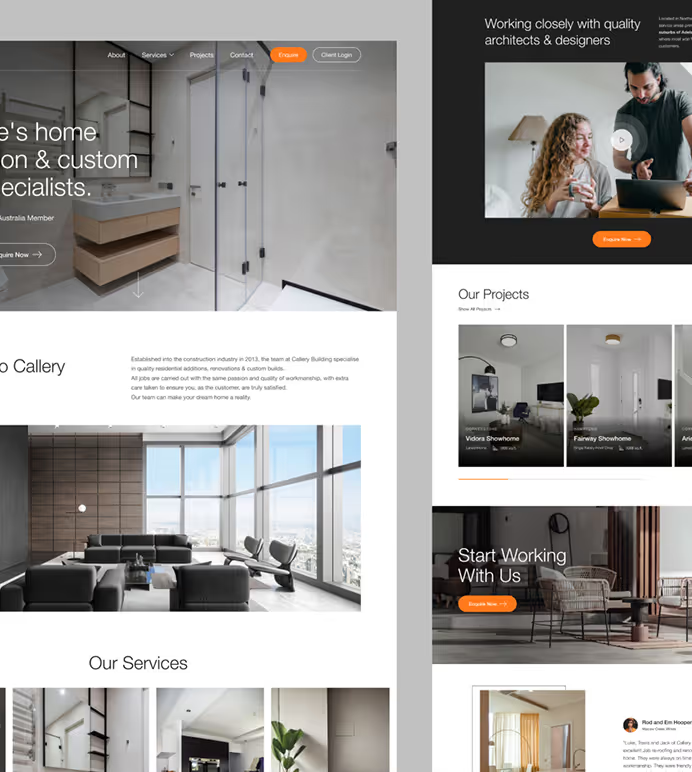
Complex builds are usually agency work. Freelancers handle simpler sites well, but page count, features and integrations drive the price hard. The design fee and the build fee are separate line items. A $5,000 design quote often comes with another $10,000 to $20,000 for development, depending on the platform. Our guide to website design cost splits the two out.
Illustrations: ~$500 – $1,600
Style and complexity can push estimates higher, especially for bespoke artwork. Also price can depend on whether you’re hiring an illustrator directly or through a representative agency.
Print & Packaging: ~$50 – $3,000
Business cards and brochures sit at the low end. Custom packaging, book layouts and multi-SKU label systems sit at the top. As one-off tasks, printed materials are among the most affordable design work you can buy.
Graphic design hourly rates in 2026
Freelance graphic designers in 2026 typically charge $25–$150/hr, depending on experience and location. Most mid-level remote freelancers fall in the $45–$85/hr range for standard graphic design work. Agencies bill at $75–$175/hr, usually with a project minimum that effectively sets a floor around $1,500–$3,000.
By experience level:
- Entry-level ($25–$45/hr): 1–3 years of experience. Suitable for simple, well-defined tasks with limited revision cycles. Quality and turnaround can be inconsistent — this range requires close briefing and more oversight.
- Mid-level ($45–$85/hr): 3–7 years of experience. Handles most standard graphic design work well. The most common range for remote freelancers working on marketing and branding projects.
- Senior or specialist ($85–$150+/hr): 7+ years of experience, or niche expertise in areas like motion design, packaging, or UX. Worth the rate for complex, brand-defining work where getting it wrong is expensive.
By location: US, UK, and Australian-based designers sit at the higher end of these ranges. Eastern European designers typically charge $20–$50/hr; Southeast Asian designers $15–$40/hr. Time zone overlap and communication quality still matter regardless of rate.
In-house for comparison: According to the US Bureau of Labor Statistics, the median annual salary for graphic designers sits around $58,000–$65,000 in the US. Add benefits, payroll taxes, equipment, and the time cost of hiring, and the real total is typically $70,000–$90,000+ per year. That's before you factor in the months it can take to find the right person.
Freelancer vs agency vs subscription: pricing compared
The three main models for accessing graphic design serve different needs at very different price points. Freelancers suit one-off projects. Agencies suit high-stakes strategic work. Subscriptions suit businesses with steady, recurring design needs. Most growing companies end up using a mix of all three at different stages.
Freelancers
Freelancers make the most sense for discrete, well-scoped projects. The catch is that quality varies enormously, vetting takes real time, and rates compound quickly once you have multiple monthly requests.
Best for: specific one-off tasks or specialist bursts of work ✅
Not ideal for: weekly recurring output, where sourcing and managing becomes its own job ❌
Design agencies
Agencies are the right call for high-stakes brand work: a full rebrand, a campaign that needs strategy alongside execution, or a complex website where design and development have to be coordinated. They are not built for a steady flow of weekly marketing assets, because the per-project model turns every new request into a new negotiation. Our breakdown of design agency pricing covers what sits inside a typical quote.
Best for: deep strategic projects like full branding and complex websites ✅
Not ideal for: routine marketing production, where you are paying agency overhead for execution work ❌
Unlimited design subscriptions
Subscription services are designed specifically for businesses that need design regularly. You pay a flat monthly fee and submit requests as needed, with a professional team handling output every business day. ManyPixels covers everything from social media graphics to web design and illustrations within a single plan, with next-day delivery and unlimited revisions included. Plans run from $699/month (Advanced) to $2,599/month for a dedicated two-designer team.
For a deeper breakdown of real-world cost comparisons, see are design subscriptions cheaper than freelancers? and design subscription vs agency retainer.
Best for: ongoing content pipelines with predictable monthly costs ✅
Not ideal for: a single one-off project, where a freelancer is usually cheaper ❌
What do design subscriptions actually cost?
Design subscription prices in 2026 range from about $499 to $5,000 per month. ManyPixels starts at $699/mo for the Advanced plan. Penji's Business plan is $995/mo but is self-managed and scope-limited, with Marketing and Ads at $995/mo as its real full-scope entry point. Design Pickle provides custom quotes based on an hour-based model, and Superside starts at $15,000/mo, with a minimum one year commitment.
Be real: the headline number is the wrong thing to compare. Penji's $499 tier is the cheapest figure in that table, and it is also the one that hides the most. Self-managed means you do the briefing and the traffic management yourself, and scope-limited means the deliverable list is shorter than it looks. Compare the tier that actually covers what you need, which for most marketing teams puts Penji at $995 rather than $499.
The same logic applies to hour-based pricing. Design Pickle sells you hours, not output, so the real question is how many usable assets those hours produce for your particular brief. For a deeper look, see Design Pickle vs ManyPixels vs Penji vs Superside and our ranking of design subscription services.
Example pricing scenarios
Real costs depend entirely on your situation. Here are three realistic scenarios — a startup building a brand from scratch, a marketing team with weekly recurring needs, and an e-commerce business with seasonal peaks — to show how the numbers actually play out across different models.
Scenario 1: Startup launching a brand
You need a logo, brand guidelines and a landing page. One-time work, clear scope, no ongoing volume yet. A mid-level freelancer would charge $400 to $800 for the logo and $600 to $2,000 for the landing page, so $1,000 to $2,800 in total. A subscription at $699/month covers the same work plus everything that comes after it. If you plan to keep producing content once the brand is live, the subscription pays for itself inside the first month or two. More on design options for startups.
Scenario 2: Marketing team with weekly design needs
You are producing social graphics, display ads and email headers every week. At freelance rates of $55/hr, five social graphics a week at roughly two hours each works out to $550 a week, or about $2,200 a month. A subscription at $699 to $1,199/month covers the same output with no per-asset negotiation and no availability gaps. Design services for marketing teams goes into how the workflow differs.
Scenario 3: E-commerce business with seasonal campaigns
High design volume for three or four months a year, quiet the rest of the time. This is where the pause option matters most: you can run a subscription at full capacity during peak season and pause it for $10/month when things go quiet, rather than keeping a freelancer relationship warm or paying for an agency retainer you are not using. See ecommerce design services and time versus cost for popular design services.
How to choose what's right for you
It comes down to three questions: how often you need design, whether you need a specialist or a generalist, and how much cost predictability matters.
✅ Choose a freelancer if you have a specific, well-scoped project, you want a particular specialist such as a packaging or motion designer, or your needs are genuinely infrequent at fewer than two or three requests a month.
✅ Choose an agency if you are doing a major brand overhaul, launching a campaign that needs strategic direction alongside execution, or building a complex website where design and development have to be coordinated from the start.
✅ Choose a subscription if you have ongoing, recurring design needs across marketing, social or product, especially if you are submitting more than one request a week and want a team that learns your brand over time.
❌ Avoid hiring in-house too early. Unless you have consistent full-time work and the budget for salary plus benefits, a subscription or a freelancer is more flexible and more cost-effective at most stages of growth.
The number most people miss is cost per delivered asset, not cost per month. Work that number out for your actual volume before you compare any two quotes.
Why teams choose ManyPixels
If your design needs are recurring rather than one-off, here is what a ManyPixels subscription covers:
- 💰 Flat monthly pricing from $699/mo, with unlimited requests, unlimited revisions and unlimited brands on every plan.
- ⚡ Daily output on business days, with first drafts typically back in 24 to 48 hours.
- 🎨 Broad scope in one plan, including web design on the entry tier, which most competitors gate behind a higher plan.
- 👉 Pause for $10/month when things go quiet, and keep every file and request in your account.
- 📊 Full ownership, with native source files and complete copyright transfer on delivery.
To me, it's great value to pay a monthly subscription and get access to an entire design team, instead of hiring a designer who would likely cost more. - Joe Howard, Founder, WP Buffs
ManyPixels has delivered more than 150,000 projects for over 2,000 businesses since 2018, and holds 4.8/5 on Trustpilot and 4.9/5 on G2. Explore ManyPixels plans to see which tier matches your volume.
FAQs
Bottom line
For one-off projects, hire a freelancer and expect to pay $200 to $800 for most single deliverables.
For recurring work above three or four requests a month, a subscription is cheaper per asset and far easier to budget, starting at $699/month.
Agencies earn their fee on rebrands and complex builds, and almost never on routine marketing production.
Whatever you choose, price the scope rather than the headline. ✅
{{GRAPHIC_BANNER="/dev/components"}}

Having lived and studied in London and Berlin, I'm back in native Serbia, working remotely and writing short stories and plays in my free time. With previous experience in the nonprofit sector, I'm currently writing about the universal language of good graphic design. I make mix CDs and my playlists are almost exclusively 1960s.

Top-quality designers
A complete creative team at your fingertips: graphic and web designers, illustrators, and more.

Lightning-fast turnaround
Get start today and receive your first update on the next business day.

All-inclusive pricing
Unlimited requests and revisions. One flat monthly fee. No surprises.

Flexible & scalable model
No contract. Scale up and down as needed. Pause or cancel at anytime.
Continue reading


Explore some of our best designs
Get inspired by a curated selection of ManyPixels work. Download the portfolio to see what our team can create.