What to do if your design agency clients don’t like your work
.png)
TABLE OF CONTENTS


TL;DR
Most client complaints about design work are preventable with a tighter brief and clearer revision terms. When they happen anyway: check the feedback against what was agreed before responding, use data to back your decisions, and stay on the same side as the client rather than across from them. If expectations were unrealistic before work started, the reset conversation needs to happen before you design anything. Some client relationships won't be fixable. That's information too.
Introduction
A client emails back after seeing your work. They don't like it. Maybe the feedback is vague ("it just doesn't feel right") or specific in ways that contradict what they asked for. Either way, you're caught between defending the work and keeping the relationship intact.
This happens in every design agency, at every skill level. Since 2018, ManyPixels has delivered design work to 2,000+ businesses across industries, and we've been part of more of these conversations than we can count. And the biggest lesson we’ve learned is that most client dissatisfaction isn't really about the quality of the work. The best defense against unhappy design clients isn't better design. It's a better process for everything before and after the design gets made.
Why design clients push back (and the right mindset going in)
When a client doesn't like your work, resist the instinct to defend it immediately. Check whether their feedback contradicts the brief. If it does, you have evidence on your side. If it doesn't, you have a genuine conversation to have. Either way, your job is to stay on the same side as the client, not positioned across from them.
There's no such thing as a bad client. - Bob Gill
This famous designer’s saying may not always ring true when you read pages of client feedback. But a client pushing back on your work usually isn't doing it to be difficult. They want what's best for their business. They often lack the vocabulary to explain precisely why something isn't working for them, but it’s the job of the designer to make the design work.
That framing changes the dynamic before you even reply. Before you respond or revise anything, get into the right position:
- Be ready to take criticism without making it personal
- Be prepared to explain your decisions in plain language, not design jargon
- Stay open to the possibility that they're seeing something you've missed
- Make space for dialogue rather than a defense
When client expectations are unrealistic before you start
If a client's expectations are unrealistic, the problem almost always starts before a single pixel is placed. The fix is to reset scope before work begins: show reference examples that match the brief, clarify what's achievable within the budget and timeline, and get written sign-off. Resetting expectations after the fact is harder, but the same logic applies.
The warning signs show up early. A client who says "just make it look premium" without defining what that means. A brief with a $500 budget and a reference folder full of Fortune 500 rebrand work. A request for a "quick" website redesign with no content ready and a two-week deadline.
When you spot these signals, address them before you start.
Show them calibrated references. Pull examples that are actually achievable within their budget and timeline. Walk them through why those comparisons are more realistic than the inspiration they've shared. This isn't about discouraging them. It's about protecting both of you from a harder conversation later.
Define what's in scope and what isn't, in writing. Use the kickoff conversation to cover not just what you'll deliver but what you won't. "This project includes X and Y. If Z comes up during the process, here's how we'll handle it." That one sentence prevents a significant percentage of scope disputes.
{{PRINT_PORTFOLIO="/dev/components"}}
Get sign-off before you start. A written agreement, even a confirmed email thread, gives you both something concrete to return to if expectations shift during the project.
If you're already past the start line and the gap has surfaced mid-project, the same logic applies. Go back to what was agreed, be honest about what's achievable with the remaining time and resources, and have the conversation directly rather than trying to close the gap quietly by overdelivering out of scope.
Before you design: how to prevent most client complaints
Most client complaints about design work can be prevented before you start designing. Here are 4 key steps you can take to avoid conflict later on.
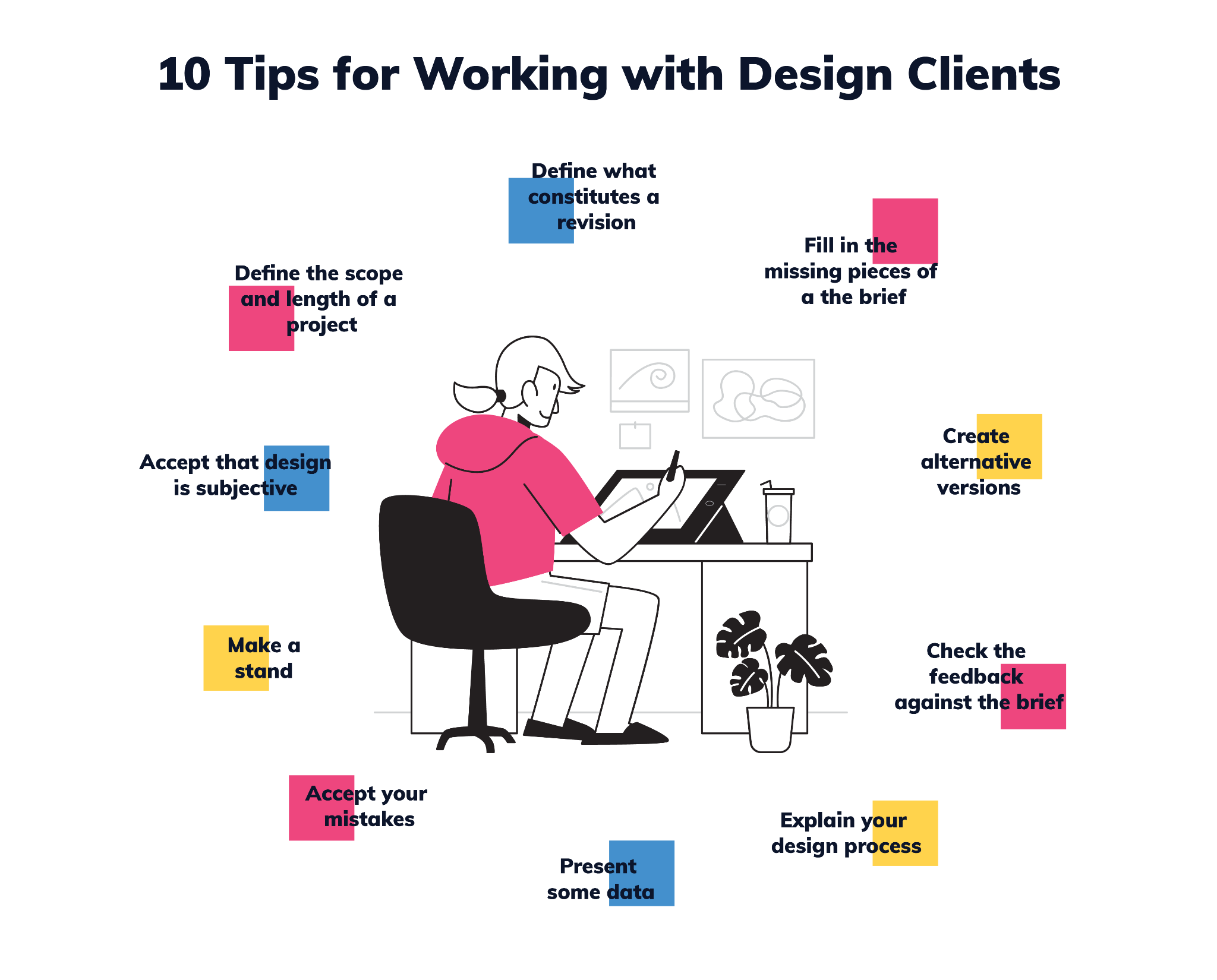
1. Define the scope and length of a project
Most clients don't understand the design process. What takes you a full day may seem like an hour's work to them. They'll also forget secondary deliverables: adapting a design for different formats, adjusting colors for print, delivering files in multiple sizes.
Before you quote or start, agree on: the type of project and what variations are included; the timeline for first drafts, revisions, and final delivery; and how communication will work. Getting this documented before work begins eliminates the most common source of post-delivery conflict. For a more detailed breakdown, see our guide to what graphic designers actually deliver on different project types.
2. Define what counts as a revision
There's a wide gap between adjusting a font weight and scrapping the concept entirely. If you promise revisions without defining them, clients will use that promise to request fundamentally new work.
Set clear parameters: a deadline for requesting revisions after delivery; the number of rounds included; and what constitutes a revision versus a scope change. Changing the color or copy is a revision. Changing the concept or adding deliverables is a scope change. Include pricing for additional rounds. Clients who understand this structure from the start almost never push against it.
3. Fill in the missing pieces of the brief
There are two kinds of clients: those who specify every detail, and those who say "I trust your judgment." Both are challenging for different reasons.
Once a brief is submitted, it's your job to find the gaps before you start. Have they provided brand colors? References? Specified the audience? For larger projects, a 30-minute kickoff call to walk through the brief is worth more than two extra revision rounds later.
4. Create alternative versions
Clients respond well to options. Even when the brief is clear, presenting two creative directions gives you a safety net. If the primary concept doesn't land, you have a second to discuss rather than starting from scratch.
Alternative versions also help you scope out routes the client wants to avoid. Showing them what you won't pursue can be as useful as showing them what you will. And at ManyPixels, giving clients options is one of the things customers mention most when describing what makes the process work well for them.
When the feedback comes in: what to do step by step
When a client says they don't like the work, check the brief before you reply. There are really only two scenarios: they're rejecting something they asked for, or they're rejecting something you interpreted creatively. The first gives you evidence. The second gives you a conversation to have. Either way, don't treat vague feedback as actionable. "I don't like it" tells you nothing. "I don't like the color palette because it doesn't feel professional enough" gives you somewhere to go.
5. Check the feedback against the brief
Pull up the brief before you respond to critical feedback. If the client is objecting to something they specifically requested, that's a different situation than if they're reacting to a judgment call you made on your own.
When feedback contradicts the brief, say so calmly: "I want to make sure I understand. This direction was part of the original brief. Can you help me understand what's changed?" You're not arguing. You're asking for clarity. For more on how to structure this kind of feedback conversation, our design feedback framework lays out the mechanics on both sides.
When feedback points to a genuine miss on your part, acknowledge it directly. Clients respond well to honesty. They respond poorly to deflection.
6. Explain your design process
Most clients don't know how long things take or why specific decisions were made. Recording your time on tasks gives clients a realistic frame for what the work actually involves. Walking them through your reasoning ("I chose this typeface because your audience skews professional and the brand tone is authoritative") changes the dynamic from evaluation to collaboration.
You're not asking them to accept the design. You're helping them evaluate it more precisely.
7. Present some data
If explanation hasn't moved the conversation, move from opinion to evidence. You don't need to win on taste. Show them why the approach works on an objective level.
A few statistics worth keeping in your toolkit:
- Research published on ResearchGate suggests 94% of first impressions are design-related
- Users form an opinion about a website in as little as 50 milliseconds, according to Lindgaard et al. (2006) in Behaviour and Information Technology
- People make up their minds within 90 seconds of encountering a product, with 62-90% of that assessment based on color alone, according to Singh (2006) in Management Decision
You can also reference your own client outcomes. If a design approach you're defending has driven measurable results for other clients, say so. A relevant case study is more persuasive than any published statistic.
If you want to go deeper on why graphic design matters to business outcomes, that's a useful reference to share with clients who are skeptical of the impact.
When you need to push back (and when to let the client win)
Not every piece of feedback deserves a fight. Own your mistakes directly when they're yours. When a client is choosing a direction you believe is wrong, say so once, clearly and with reasoning. Then let them decide. It's their brand. Push back on decisions you believe will hurt the work. Don't push back on preferences you simply don't share.
8. Accept your mistakes
Missing a deadline, misreading the brief, producing something technically off: these happen. What clients are actually evaluating is how you handle it.
When you've made an error, be proactive. Don't just flag the problem. Come with a solution and, where appropriate, a small goodwill gesture: an extra asset, a faster turnaround on the revision, something that shows you're invested in making it right. Clients remember how mistakes were handled far longer than they remember the mistakes themselves.
9. Make a stand when needed
You know better than the client what makes design work effective. That expertise is part of what they're paying for. Delivering poor design because the client prefers it is unprofessional, and ultimately bad for your reputation.
When a client is pushing for something you believe will hurt the work, say so. Not aggressively, but clearly: "In my professional experience, this approach tends to reduce readability. Here's what I'd recommend instead, and why." Then back it up: examples of similar approaches, data on user behavior, comparable work from your portfolio.
It's also useful to share resources on what separates good design from bad design when the conversation needs a neutral reference point.
You can tell a client that if they'd prefer to proceed against your recommendation, you'd ask not to be credited for the work. That's a significant signal. It often prompts them to reconsider.
10. Don't forget that design is subjective
Even when you've done everything right, a client can still dislike the result. Taste is real. At that point, the most useful thing you can do is get to know the client better: what they respond to emotionally, what they associate with their brand identity, what they've reacted strongly to in the past.
Over time, this knowledge makes you better at anticipating their preferences. You'll disagree less often, not because your standards have lowered, but because you understand not just the brief but the person behind it.
When the relationship isn't working: how to part ways
Some clients can't be satisfied, and recognizing this early is a professional skill. If you've revised the work multiple times and the feedback keeps shifting or contradicting itself, it's reasonable to have a direct conversation about fit. Ending the relationship professionally, by returning what's fair and handing off files cleanly, does more for your reputation than grinding through an impossible brief.
Most client conflict is resolvable. But not all of it.
The signals that a relationship isn't working: every revision round introduces new requirements that weren't in the original brief; feedback from different stakeholders contradicts itself with no clear resolution; stated approval criteria keep shifting after work is delivered.
If you're three or four rounds in and the goalposts are still moving, name it directly: "I want to make sure we're aligned on what we're working toward. Can we go back to the original brief and confirm what success looks like here?" That conversation either produces clarity or confirms the fit isn't there.
Walking away gracefully protects your time, your team's morale, and the clients who are worth your best work. Offer to refund work that wasn't delivered as agreed. Hand off all files. Keep the tone professional throughout.
Clients who are impossible to please will be impossible to please no matter how good the next revision is. Some engagements cost more to continue than to end.
Is there an easier way to make design agency clients happy?
As you can see, managing client expectations well is a real process. It takes time, skill, and designer hours that compound quickly when you're handling multiple client accounts.
For agencies looking to scale design capacity without adding headcount, an unlimited design subscription can absorb overflow work and bring more consistency to the output your clients see. ManyPixels works with agencies as an extension of their team, with plans starting from $699/month for managed design output and an Assigned Designer option at $1,399/month for dedicated capacity. Unlimited revisions are included across all plans, which removes one of the more common friction points before it starts.
FAQs
Bottom line
Most client complaints about design work are preventable. A tighter brief, clear revision terms, and a calibrated conversation about expectations before work starts will handle the majority of situations before they become problems. When complaints happen anyway, check the brief, explain your reasoning, and back your decisions with data before your opinion.
💡 Push back on decisions that will hurt the work. Let clients win on preferences. And if a relationship can't be fixed after a good-faith effort, walking away professionally is the right call.

Having lived and studied in London and Berlin, I'm back in native Serbia, working remotely and writing short stories and plays in my free time. With previous experience in the nonprofit sector, I'm currently writing about the universal language of good graphic design. I make mix CDs and my playlists are almost exclusively 1960s.

Top-quality designers
A complete creative team at your fingertips: graphic and web designers, illustrators, and more.

Lightning-fast turnaround
Get start today and receive your first update on the next business day.

All-inclusive pricing
Unlimited requests and revisions. One flat monthly fee. No surprises.

Flexible & scalable model
No contract. Scale up and down as needed. Pause or cancel at anytime.
Continue reading



Explore some of our best designs
Get inspired by a curated selection of ManyPixels work. Download the portfolio to see what our team can create.