6 Shopify scams to know and how to report them
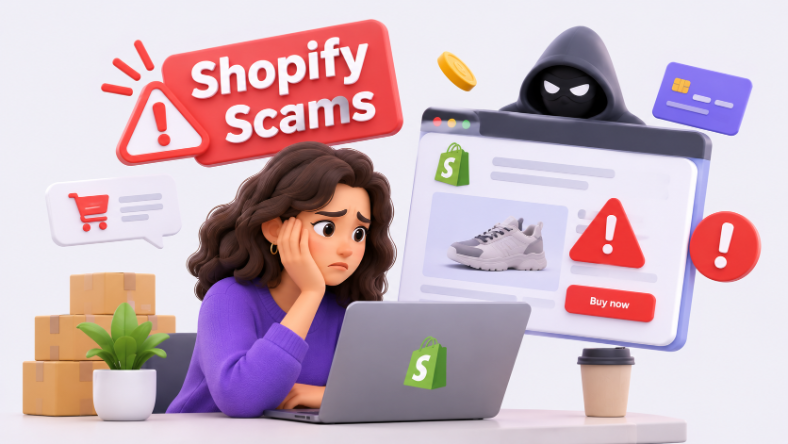
TABLE OF CONTENTS


TL;DR
Shopify is a legitimate ecommerce platform, but scammers use it like anyone else. Some build fake stores that take shoppers' money and vanish. Others go after merchants with stolen cards, fake PayPal notices and empty-box returns. If a Shopify store scammed you, dispute the charge with your bank or card issuer, then report the store to Shopify.
- ✅ Is Shopify legit? Yes. The platform is Level 1 PCI DSS compliant, and every store on it inherits that. The risk is the individual store, not Shopify.
- ⚠️ Biggest risk for shoppers: fake or cloned stores, usually found through social media ads, that never ship.
- ⚠️ Biggest risk for merchants: chargebacks. Shopify isn't liable for them, and a lost chargeback costs you the order, the product and a fee.
- 💰 Scammed as a buyer? Call your card issuer first. Shopify doesn't refund buyers for a store's orders, but your bank can reverse a card payment.
- ❌ Never move a payment off Shopify because a customer asks, and never ship on the strength of a "payment received" email alone./
Ecommerce platforms let a small business sell to anyone, anywhere, with a store that takes an afternoon to set up. That same ease is what makes them useful to scammers. A fake store costs as little to launch as a real one.
Below are the six Shopify scams that come up most often, who each one hits, the warning signs, and exactly where to report them. There's a separate section for shoppers who've already been scammed, because that's the situation most people searching this are in.
Is Shopify legit?
Yes. Shopify is a publicly traded Canadian company and one of the largest ecommerce platforms in the world. On the security side, Shopify is certified Level 1 PCI DSS compliant, the highest tier of the card industry's security standard, and that compliance extends to every store on the platform by default. Stores also get an SSL certificate, so checkout data is encrypted.
What Shopify doesn't do is vet every merchant before they start selling. Anyone can open a store. So the useful question isn't "is Shopify legit?" but "is this Shopify store legit?" Shopify's own help center for shoppers puts it plainly: the store you buy from is responsible for fulfilling your order and processing refunds, while Shopify handles checkout security and the reporting tools.
The 6 most common Shopify scams, who they target, and the first defense
1. Fake and duplicate stores
This is the scam that hits shoppers hardest, and it's also how a real merchant can lose sales to a copy of their own store. Scammers clone a legitimate store's product photos and copy, register a lookalike domain, and run ads to it. The products, from printed t-shirts to branded homewares, either never ship or arrive as cheap knockoffs.
The best-known case involved MyPillow. In 2018 Mike Lindell's company found that a scammer had used Shopify to build mypillowstore.com, a near copy of the real mypillow.com. My Pillow sued Shopify that April for allegedly supporting trademark infringement, and Shopify took the fake site down. At the time, Shopify said it had a team dedicated to finding and removing fake stores like it.
Warning signs for shoppers: a domain that's almost right, prices far below what the brand charges elsewhere, no physical address or a fake one, and a store you only found through an ad.
If your store has been copied: report it to Shopify under Intellectual property on the Report a merchant page, and screenshot both stores side by side first, in case the clone disappears before Shopify reviews it.
2. Triangulation fraud
Triangulation fraud involves three parties, and two of them are victims. A scammer sets up a store and takes real orders from real shoppers. They don't hold any stock. Instead, they buy each item from a genuine merchant using a stolen card and have it shipped straight to the shopper.
The shopper gets their order and never suspects anything. The scammer keeps the shopper's money. The genuine merchant, the one who shipped the item, gets hit weeks later when the real cardholder spots the charge and disputes it. That merchant loses the product, the sale and a chargeback fee. Shopify's help center is clear that Shopify isn't liable for chargebacks, and on Shopify Payments the amount comes out of your next payout.
Warning signs for merchants: a billing address in one place and a shipping address in another, several orders with different cards going to related addresses, and orders that Shopify's fraud analysis marks as high risk. If an order looks wrong, cancel it before you capture payment and fulfil.
3. Fake PayPal payment notice
This one, sometimes called the switching scheme, was common on eBay long before Shopify. A buyer places an order, then says checkout isn't working for them and asks you to send a PayPal invoice directly instead.
Soon after, you get an email that looks like it's from PayPal. It says the buyer has paid, and that the money is on hold until you send a tracking number. There is no hold, because there is no payment. The email is fake. Send the tracking number, ship the order, and the scammer has your product for free.
How to protect yourself: never confirm a payment from an email. Log in to PayPal (or your Shopify admin) directly, without using any link in the message, and check that the money is actually there. A real PayPal payment is never "waiting for a tracking number" before it appears in your balance.
4. Off-platform payment requests
This scam takes patience, which is why it works. A buyer places one or two normal orders, pays, and is pleasant to deal with. Once you trust them, they suggest that next time you both skip Shopify's fees: they'll send their card details directly, or pay by bank transfer, and you ship.
Outside your Shopify checkout, you lose its fraud screening, its records and any protection on the payment. The card details are often stolen, so the payment is reversed later and you're left without the money or the goods.
How to protect yourself: keep every sale inside your checkout, even for a repeat customer you like. A buyer who can't use a normal checkout is a buyer to be careful with.
5. Fake returns
Simple and effective. Someone poses as an unhappy customer and asks for a refund. They send a return tracking number that's fake, belongs to a different parcel, or tracks a box that turns out to be empty or full of something worthless. If you refund before the return arrives, you lose the product and the money.
How to protect yourself: write a returns policy that says refunds are issued once the item is received and inspected. Check that return tracking shows a weight close to what you shipped, and photograph returned parcels when you open them, so you have evidence if the customer then files a chargeback too.
6. Stolen-card orders and false chargebacks
The last scam comes in two forms. In the first, a scammer orders from you with a stolen card, often a high-value item with rush shipping, and is gone before the real cardholder disputes it. In the second, a real customer receives their order and then tells their bank it never arrived, or that they didn't make the purchase. Either way, the chargeback lands on you.
Shopify gives US merchants one strong defense here. Shopify Protect covers the order cost and chargeback fee on eligible fraud-based chargebacks for Shop Pay orders processed through Shopify Payments, at no extra cost. To qualify, you need to fulfil within seven days and add tracking from a supported carrier. It only covers fraud-based chargebacks, so for "item not received" claims your defense is still the evidence you keep.
How to protect yourself: use tracking on everything, require a signature on high-value orders, and keep order records, customer messages and delivery confirmations together so you can respond to a dispute quickly.
Scammed by a Shopify store? What buyers should do
If you bought from a store that never shipped, sent something worthless, or has since disappeared, here's the order to work in. Speed matters most for the first step.
- Contact your bank or card issuer and dispute the charge. This is your best chance of getting your money back. The FTC's advice if you paid a scammer by card is to tell your card company it was a fraudulent charge and ask them to reverse it. For credit cards, follow up in writing; the FTC explains the time limits in its guide to disputing credit card charges. If you paid through PayPal, open a dispute in your PayPal account. If you paid with Shop Pay Installments, the dispute goes through Affirm, as Shop's help center explains.
- Contact the store once, in writing. Use the email on your order confirmation or the contact option in the Shop app. If it bounces or nobody answers, that's useful evidence for your dispute.
- Report the store to Shopify. Use Shopify's fraud report form if you think the store is a scam, or the order issue form for a problem with a specific order. Shop says that once you dispute a transaction, Shopify is notified and can investigate the store.
- Report it to your national fraud agency. In the US, that's the FTC at ReportFraud.ftc.gov. In Canada, the Canadian Anti-Fraud Centre. In Australia, Scamwatch.
- Keep everything. Screenshot the store, the product page, the ad you clicked and your order confirmation now. Scam stores often disappear within days, and the order link stops working with them.
One thing to know before you start: Shopify doesn't refund buyers for a store's orders. Your money comes back through your bank or payment provider, not through Shopify, which is why the dispute comes first.
How to spot a fake Shopify store before you buy
- Check the domain. A store that only lives on a .myshopify.com address, or on a domain that's one letter off a known brand, deserves a closer look.
- Search the store name with "scam" or "reviews". Look for reviews off the store's own site. A store with no footprint anywhere else is a risk.
- Look for real contact details. A working email, a physical address you can verify, and a returns policy written for that store, not copied boilerplate.
- Be wary of the deal. Steep, permanent discounts and countdown timers on every product are common on scam stores.
- Pay by credit card where you can. It gives you the strongest dispute rights if something goes wrong.
How to report a Shopify scam
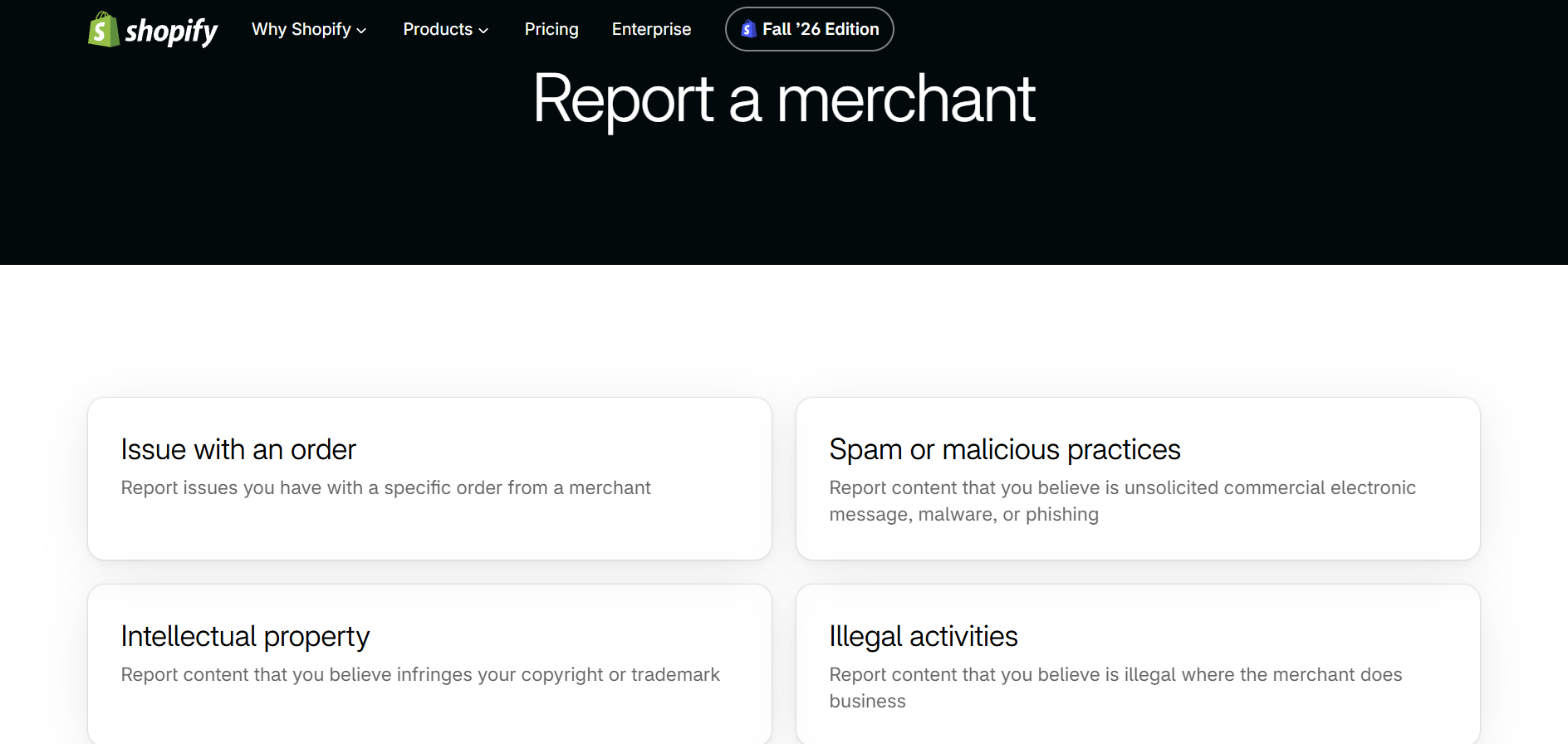
Shopify's reporting tools live on its Report a merchant page. The most common reasons are:
- Fraud: a store you believe is running a scam. This is the right choice for most fake stores.
- Issue with an order: a problem with a specific order, like non-delivery. Shop notes that if your order hasn't arrived and more than 30 days have passed without a reply from the store or carrier, you can report it for investigation.
- Intellectual property: a store copying your brand, products or content.
- Spam or malicious practices: phishing, malware or spam sent by a store.
If you shop through the Shop app, you can also report a store from its page in the app: tap Report and choose a reason.
For merchants, the reporting side is different. Forward any email that claims to be from Shopify but looks wrong to phishing@shopify.com. Shopify says it only emails from official domains such as @shopify.com, @email.shopify.com and @em.shopify.com, and that anything from Gmail, Yahoo or another public email service isn't from Shopify. Scammers posing as Shopify support, "Shopify experts" or app developers are a scam category of their own, and the same red flags we cover in our guide to Fiverr scams apply here: pressure to act fast, and a request to move the conversation or the payment somewhere else.
How merchants can protect their store
- Review every high-risk order. Shopify's fraud analysis flags them. Cancel before you capture payment if the details don't add up.
- Keep payments in your checkout. No direct invoices, no card numbers by email, no bank transfers to "save fees".
- Turn on two-step authentication for every staff account on your Shopify store.
- Use Shopify Protect if you're a US store on Shopify Payments, and fulfil with tracking within seven days so orders stay eligible.
- Save proof of every transaction: order details, customer messages, tracking and delivery confirmation. Chargebacks are won with evidence.
Make your real store easy to recognize
Clone stores work because shoppers can't tell the copy from the original. You can't stop someone copying your product photos, but you can make the real thing harder to fake. A consistent visual identity across your store, your order and shipping emails, your social accounts and your packaging gives customers more points to check. When the "brand" on an ad doesn't match the emails they've had from you before, they notice.
That consistency is ongoing design work, and it's the kind we do every day. ManyPixels is a design subscription that handles store banners, social graphics, digital ads, email graphics and packaging for ecommerce brands.
- 💰 Advanced plan from $699 a month, with up to 2 hours of design a day
- ✨ Unlimited requests and revisions, and you own 100% of the designs
- 🚀 Pause for $10 a month when you don't need design, cancel anytime
FAQs
Bottom line
Shopify is safe to use. The scams on it are run by individual stores and individual "customers", and nearly all of them depend on one of two things: a shopper who doesn't check the store, or a merchant who lets a payment leave the checkout.
- ✅ Shoppers: check the domain and reviews before you buy, pay by credit card, and dispute the charge with your bank first if it goes wrong.
- ✅ Merchants: review high-risk orders, keep every payment in your checkout, and save proof of every sale.
- ⚠️ Both: report scam stores to Shopify. Fake stores get taken down faster when more people report them.

Journalist turned content writer. Based in North Macedonia, aiming to be a digital nomad. Always loved to write, and found my perfect job writing about graphic design, art and creativity. A self-proclaimed film connoisseur, cook and nerd in disguise.

Top-quality designers
A complete creative team at your fingertips: graphic designers, illustrators, motion designers and more.

Lightning-fast turnaround
Get started today and receive your first update on the next business day.

All-inclusive pricing
Unlimited requests and revisions. One flat monthly fee. No surprises.

Flexible & scalable model
No contract. Scale up and down as needed. Pause or cancel anytime.
Continue reading


Explore some of our best designs
Get inspired by a curated selection of ManyPixels work. Download the portfolio to see what our team can create.