Design budget planning for 2027: how much to spend and where
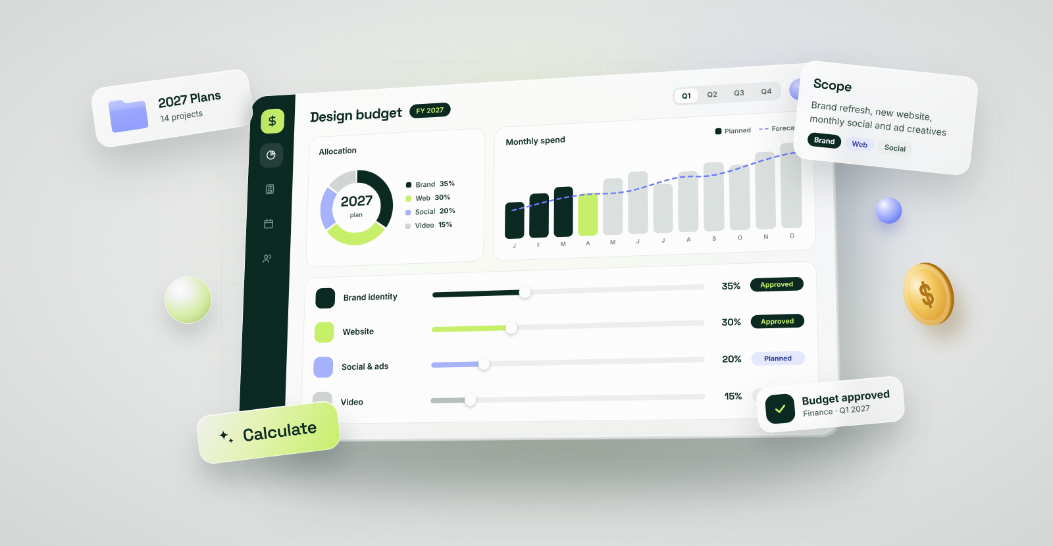
TABLE OF CONTENTS
TL;DR
Most companies should give design about 10% of the marketing budget. With marketing at 7.8% of revenue, that works out to roughly 0.8% of revenue a year. At that rate, a $699 a month design subscription fits once revenue passes about $1.1M, and a full-time in-house designer only fits past about $11.8M.
- ✅ Start from your asset list, not a percentage. Count what you need delivered in a normal month, price it, then check the total against 0.8% of revenue.
- 💰 Under $1M in revenue: budget per project. A freelancer and templates cover most of it, and $699 a month is more than the benchmark allows.
- 🎨 $1M to $10M: a design subscription is the core line. ManyPixels runs $699 to $2,599 a month on monthly billing.
- ⚠️ Re-price any 2025 quotes. Penji's entry plan is now $995 after its $499 tier was removed, and Delesign raised both plans by about 40% in 2026.
- ❌ Don't hire in-house too early. A designer on the US median salary costs about $91,900 a year once benefits are included.
Budget season usually treats design as a leftover. Paid media gets a line, the tools get a line, and design gets whatever is left after the website quote comes in. Then the year starts, the ad team needs 40 new creatives in March, and the design spend ends up on someone's credit card.
The guides that rank for this question don't help much. Most were written years ago, and the one number they offer is so wide it's useless: one says some companies put 25% of marketing toward design and others put 80%.
So this guide gives you numbers you can defend in a budget meeting: a benchmark from 2026 survey data, two revenue thresholds that tell you which buying model fits, and a sample budget you can copy. We sell design subscriptions, so we've shown the math behind every recommendation, including the ones where a subscription is the wrong buy.
How much should a company spend on design in 2027?
A company should plan to spend about 10% of its marketing budget on design in 2027, which is roughly 0.8% of revenue for an average company. Treat that as a check on your number, not the number itself. Your real budget should come from what you need designed each month.
Here's where the benchmark comes from. Gartner's 2026 CMO Spend Survey found marketing budgets rose only slightly, to 7.8% of company revenue in 2026 from 7.7% in 2025. Within marketing, we give graphic design 10% in our own marketing budget example.
Multiply the two and you get 0.78% of revenue. That gives you two useful thresholds:
- About $1.1M in revenue is where a 699amonthdesignsubscription(8,388 a year) fits the benchmark. On yearly billing at $559 a month, it fits from about $860,000.
- About $11.8M in revenue is where a full-time in-house designer fits, at a fully loaded cost of about $91,900 a year.
One caveat. Gartner surveyed 401 marketing leaders, and most of them work at companies with more than $1 billion in revenue. Small companies often spend a bigger share of revenue on marketing, especially early on, so read these thresholds as conservative.
Step 1: count your assets before you pick a number
The most reliable design budget is a list. Before you open a spreadsheet, write down everything you expect to need designed in a typical month, by type. Ask the people who request design, not only the marketing lead: sales asks for decks, HR asks for job ads, product asks for in-app banners.
A realistic month for a small B2B team often looks something like this:
Then price the list. Our graphic design price list covers what each asset costs from a freelancer, an agency and a subscription, so you don't have to collect quotes for every line.
Step 2: sort the list into run-rate and one-off work
Every design budget has two kinds of spend, and they need different buying models.
Run-rate work repeats every month: ads, social, email, landing pages, decks. It's predictable in volume even when each request is small. This is where flat monthly pricing saves the most, because per-project pricing charges you full setup cost on every small job.
One-off work happens once or twice a year: a rebrand, a website redesign, a product launch campaign, packaging for a new line. It's lumpy and often needs specialist skills. Budget it as named projects with a ceiling for each.
As a starting point, we'd put about 70% of the design budget on run-rate work and 30% on projects in a normal year. In a rebrand or relaunch year, move toward 50/50. If your one-off share keeps creeping above half, that's usually a sign that run-rate work is being briefed as rush projects.
How to split a design budget by company stage
Here's what 0.78% of revenue buys at each stage, and how we'd spend it. The yearly budget column is the benchmark. Adjust it up if marketing takes a bigger share of revenue at your company.
Two things stand out. First, below about $1M, the honest answer is project budgets, not a monthly plan. A subscription at that stage only makes sense if you have enough run-rate work to fill it and you're spending more than the average on marketing. Second, the jump to in-house comes much later than most founders expect, because salary isn't the full cost of a hire.
What each option costs in 2027
The buying model moves your design budget more than any other decision. Here's what each route costs going into 2027.
The in-house figure needs explaining. The US Bureau of Labor Statistics puts the median graphic designer salary at $62,960 in May 2025. Salary isn't what a hire costs, though. BLS employer cost data shows that for full-time private industry workers, wages made up 68.5% of employer costs in June 2026, with benefits making up the rest. Divide the median salary by 0.685 and you get about $91,900 a year, before software, equipment and recruiting.
Subscriptions range widely. Our design subscription pricing index tracks 15 services and found a median standing entry price of $899 a month in Q4 2026. ManyPixels plans run $699, $1,199, $1,399 and $2,599 a month on monthly billing, or $559 to $2,079 on yearly billing. Advanced includes up to 2 hours of design a day, covering graphic design, web design and illustration.
Agencies typically charge $75 to $500 an hour. Our guide to design agency pricing breaks down retainers and project fees, and the subscription vs agency retainer comparison shows the design volume where each one wins.
The line items most 2026 budgets got wrong
If your 2027 plan copies last year's design line, check the subscription and freelance figures first. Both moved a lot in 2026.
We re-check competitor pricing pages regularly for our comparison articles, and several of the prices budgets were built on in 2025 no longer exist:
The lesson for 2027: budget on the price you'll pay in month six, not the intro rate, and on the plan that actually covers your work. Two services with the same entry price can unlock web design $600 a month apart.
{{GENERAL_PORTFOLIO="/dev/components"}}
Where to put extra budget in 2027, and what to cut
Most marketing teams expect more money next year. Forrester's 2027 budget planning guides found that 89% of B2B marketing decision-makers and 91% of B2C marketers expect investment to increase over the next 12 months. Forrester's advice to B2B leaders is to use the cycle to challenge existing allocations rather than spread new money evenly.
For design, that means funding the assets closest to revenue first:
- Conversion assets. Landing pages, ad creative and sales decks. These are the easiest to tie to pipeline, and testing more ad variations is one of the cheapest wins a design budget can buy.
- Always-on content. Social, email and blog graphics. Volume matters more than polish here, which makes it the natural fit for flat monthly pricing.
- Brand foundations. Brand guidelines, templates and a photo or illustration library. They cost more upfront and lower the cost of every request after them.
What to cut: rush fees, duplicate tools, and freelance work briefed one job at a time when it's really run-rate work. If you paid three separate freelancers for social graphics in 2026, that's one line in 2027.
Where AI fits: give AI design tools their own small line instead of cutting design spend to pay for them. Gartner's 2026 data shows labor's share of marketing budgets rising from 21.9% in 2025 to 24.5% in 2026, a sign that marketing leaders are finding AI still needs skilled people to get results. AI is good for drafts, resizing and internal visuals. Anything a customer sees still needs a designer to check it against your brand.
A sample 2027 design budget for a $2M company
Here's how the benchmark turns into line items for a company with $2M in revenue. At 0.78%, its design budget is $15,600 for the year.
A few choices are worth copying. The subscription is on quarterly billing, which saves $840 a year over monthly without locking in for twelve months. Fonts and stock images have their own line, because unlicensed images cost far more than licences once a copyright claim arrives. And part of the budget is held back for July, so you can move it to whatever worked in the first half.
For a sense of what the subscription line actually produces, our breakdown of what one month of ManyPixels output looks like covers a full month of brand, web and marketing requests.
Bottom line
Build your 2027 design budget from a list of the assets you need each month, then check it against about 0.8% of revenue. Under $1M, buy by the project. Between about $1M and $10M, a design subscription is the core of the budget. Past about $12M, an in-house designer starts to make financial sense. Whichever band you're in, re-price anything quoted in 2025 before it goes into the plan.
Want to see what your run-rate design work would cost on a flat fee? Explore ManyPixels plans. And if you're comparing providers, the design subscription pricing index shows what every major service charges this quarter.
{{GRAPHIC_BANNER="/dev/components"}}

Having lived and studied in London and Berlin, I'm back in native Serbia, working remotely and writing short stories and plays in my free time. With previous experience in the nonprofit sector, I'm currently writing about the universal language of good graphic design. I make mix CDs and my playlists are almost exclusively 1960s.

Top-quality designers
A complete creative team at your fingertips: graphic designers, illustrators, motion designers and more.

Lightning-fast turnaround
Get started today and receive your first update on the next business day.

All-inclusive pricing
Unlimited requests and revisions. One flat monthly fee. No surprises.

Flexible & scalable model
No contract. Scale up and down as needed. Pause or cancel anytime.
Continue reading

Explore some of our best designs
Get inspired by a curated selection of ManyPixels work. Download the portfolio to see what our team can create.